At some point, almost every non-technical founder hits the same wall.
The idea is solid, and the market opportunity is real, but turning it into working software requires a depth of technical expertise they don't have.
They usually need a technical co-founder: someone who owns the technology, sits in the room when strategy is being set, and has as much at stake in the outcome as you do.
The data makes the stakes clear. Wrong team composition contributes to 23% of all startup failures, while startups with two founders attract 30% more investment and grow their customer base at three times the rate of solo-founder companies. The gap between a well-matched founding team and a mismatched one shows up in fundraising, product velocity, and survival odds.
Finding the right person to do that with is harder than most first-time founders expect.
My name is Yuliia Kurganova, and as a Head of Business Development, I’ve put together this guide to explain what a technical co-founder really is, what to look for, where to find one, and how to approach the conversation.
Let’s get started.
Who is a Technical Cofounder?
A technical cofounder is your business partner who helps you build and technically improve a product. This is a fully dedicated individual who takes the same level of responsibility and effort as you to create a software solution that users will love.
According to First Round Research, the chances that your startup hits the market are much higher with a co-founder. This is especially true for startup owners with no technical background. Partners with tech knowledge and programming skills can help build a product with a spectrum of competitive features.
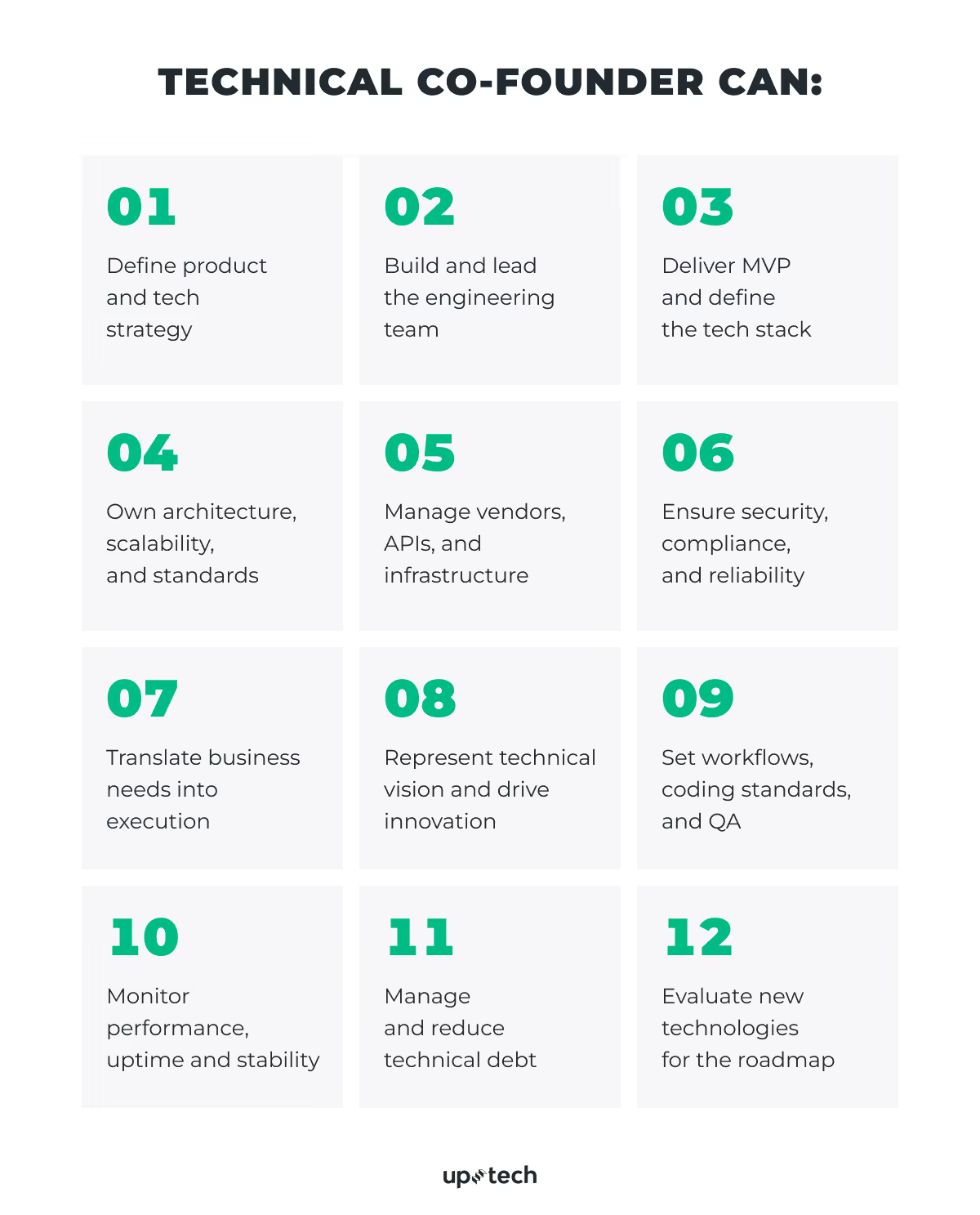
Here’s the list of tasks a technical co-founder can do:
- Building the product and technical strategy.
- Representing the technical vision to investors, partners, and customers.
- Owning the security and compliance posture of the product.
- Making architecture decisions that affect scalability, performance, and long-term maintainability.
- Drawing up the project’s tech stack.
- Managing and expanding the engineering team.
- Setting coding standards, development workflows, and quality assurance processes.
- Translating business requirements into technical specifications, the engineering team can execute.
- Managing the production of the MVP.
- Evaluating and managing third-party vendors, APIs, and infrastructure providers.
- Identifying and managing technical debt before it becomes a business risk.
- Monitoring system performance, uptime, and reliability in production.
- Staying current on emerging technologies and assessing their relevance to the product roadmap.
4 Signs You Need a Technical Co-founder
How can you tell if you need a technical co-founder instead of a skilled developer? Here are three specific cases signifying that you need a cofounder.
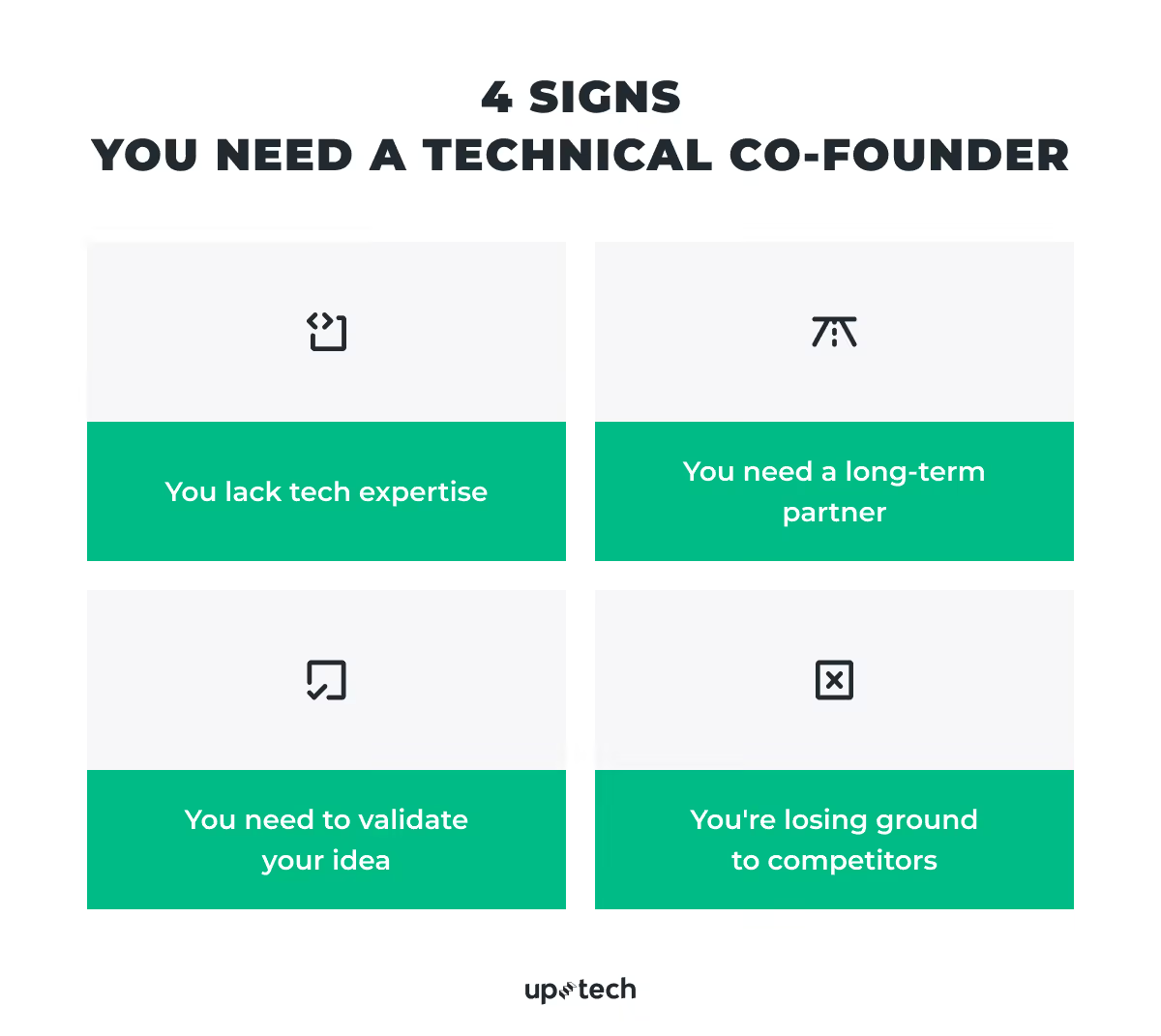
You lack tech expertise
Technical cofounders can literally help you turn your idea into reality by providing practical skills. Let’s suppose you have a breakthrough idea that is likely to hit the tech world. However, without an in-depth understanding of the technical implementation, your idea is doomed to stay on paper.
A tech-savvy and enthusiastic co-founder is the one to help you on this path. They’ll help map the technical strategy and find the right people to execute it.
You need a long-term partner
Building a startup is a multi-year commitment that will go through product pivots, hiring challenges, funding pressure, and moments where the right path forward is genuinely unclear.
A developer or an agency can build what you specify today. They cannot share the burden of figuring out what to build next, how to structure the engineering team, or how to make the right technical call when the business is at a crossroads. That kind of sustained, invested judgment is what a co-founder brings.
You need to validate your idea
Every startup begins with an assumption: that a specific problem exists, that people will pay to have it solved, and that your solution is the right one. Most of those assumptions are at least partially wrong. The goal of early-stage development is not to build the full product. It is to find out which assumptions are wrong before you have spent years and a significant amount of money on them.
A technical co-founder is key at this stage. They can quickly build a prototype, interpret data, decide what to test next, and know when results are good enough to proceed.
That combination of speed, judgment, and accountability is difficult to get from an employee who has no stake in the outcome.
You're losing ground to competitors
Speed in a technical product is about having someone who owns the roadmap, makes architecture decisions without a committee, and knows when to cut scope and when to hold the line on quality.
If your product velocity feels perpetually slow, a co-founder is the structural fix. Co-founder can help you figure out what to build next and drive it forward without being managed.

Technical Co-Founder Cooperation Models
Whatever tasks a co-founder is charged with, he/she should form a strong alliance with no drawbacks and pitfalls. Here are the options of partners you can choose for this alliance:
- Chief Technical Officer (CTO) — a paid employee
- Software development company — a technical contractor for a long-term partnership
Chief Tech Officer
If you choose to find a technical founder for your startup development, it means you are hiring an employee charged with tech and R&D issues on the project. In other words, a tech officer is your guide into the world of technological trends. This is the person who is fully aware of the latest tech trends and professionally consults you in product strategy and development.
A testament example of a complementary partnership is the alliance of Steve Wozniak and Steve Jobs.
Wozniak was responsible for technological invention and development in their cooperation, while Jobs did marketing and business management.
This professional partnership has given birth to historical products like Apple I and II computers, which revolutionized what a personal computer can be.
Pros of this model:
- Full technical ownership from day one, no management overhead
- Faster decisions, proactive technical debt management, and intentional engineering culture
- Aligned incentives: salary means they're building for the long term, not billing by the hour
Cons of this model:
- Hard to find: the right combination of technical depth, product instincts, and founder temperament is rare
- Search takes time, often months, during which product development stalls
- Choosing the wrong technical co-founder can hurt your startup far more than hiring the wrong employee in an execution-focused role. Employees can usually be replaced relatively quickly. A co-founder shapes major technical decisions and has a lasting impact on the product and team.
Best suited for:
- Startups where technology is the core product, not just a delivery mechanism
- Early-stage companies that need to move fast and can't afford the lag of outsourced or contractor-led development

Outsourcing software development company
Such a company is your outsourcing partner in developing and implementing the tasks of your business. In addition to software engineering, strong development partners often provide product strategy, business analysis, UX design, and technical architecture expertise.
Unlike a technical co-founder, a development company does not become a permanent part of the founding team. However, it can still contribute significantly to shaping the product and making key technical decisions, especially in the early stages of the business.
Pros of this model:
- Fast to start: no lengthy search, no equity negotiation, no onboarding a partner into your vision
- Broader expertise on demand: In addition to CTO-level guidance, you can tap into product, design, and engineering specialists as needed.
- Easier to exit: A development company works under a contract, making the relationship generally simpler to end than a co-founder partnership, which often involves shared ownership and long-term commitments.
Cons of this model:
- Knowledge walks out the door: when the engagement ends, so does institutional understanding of your codebase
- Quality varies significantly: vetting is critical, and the market is crowded with agencies of very different calibers
- Can become expensive at scale, often more so than equivalent in-house talent over a long horizon
Best suited for:
- Early validation stages: building an MVP to test a hypothesis before committing to a full team
- Businesses where technology is a means to an end, not the core competitive advantage
- Companies that need to move quickly on a specific build without the time or runway to hire
Uptech has numerous product development services for our clients. In such cooperation, our company works as a partner, responsible for product development. Thanks to our clients' domain expertise and our broad tech experience, unique products have been born, like GOAT — a global sneaker and apparel marketplace, Nomad — a smart real estate platform, and more.
Explore our cases here.
How to Choose The Right Model?
The right model depends on where you are in the business, what you're building, and what you actually need from a technical partner. These questions will help you figure it out.
What stage are you at?
If you're pre-product and still testing a hypothesis, you need speed and flexibility more than you need permanence. A software development company lets you validate quickly without locking in equity or long-term commitments. If you have product-market fit and are ready to scale, you need ownership and continuity, which points toward a technical co-founder or building an in-house team.
Is technology your core competitive advantage?
If your competitive advantage depends on proprietary technology, unique algorithms, or a highly specialized technical approach, you may benefit from having a technical co-founder who takes long-term ownership of that technology and helps shape its evolution over time.
If technology is primarily a way to deliver your product rather than the main source of differentiation, a software development company can still be a strong option. Many development partners provide strategic technical guidance, product thinking, and business analysis in addition to engineering, making them well suited for both product validation and execution..
How much runway do you have?
A technical co-founder costs equity but preserves cash. A software development company costs cash but preserves equity. Map your choice to your actual financial position, not the one you’re projecting.
How defined is your product?
If your product vision is still evolving, a strong software development company can do much more than write code. Experienced product partners can help clarify requirements, shape the MVP, define the technical architecture, and validate key assumptions before significant resources are committed.
This makes outsourcing particularly valuable in the early stages, when the main challenge is not just building the product, but determining what should be built and how to structure it for future growth.
As the product matures and technology becomes increasingly central to the company's long-term competitive advantage, you may benefit from bringing technical ownership in-house through a CTO or technical co-founder. However, many startups use a development partner to fulfill a co-founder-like role during the earliest stages, gaining both strategic guidance and execution without immediately giving up equity.
How quickly do you need to move?
Finding the right technical co-founder takes months. If time is the constraint, a company starts within weeks. The trade-off is the depth of investment in the outcome. Only you can decide which constraint matters more right now.
A simple decision framework
The most expensive mistake is choosing a model based on convenience rather than fit. A development company hired when you needed a co-founder will leave you with a product, but no one who owns the technology.
A co-founder brought in when you needed execution will complicate your cap table without solving your immediate problem. Be honest about what the business actually needs right now — and what it will need six months from now.
Where To Find a Technical Co-Founder?
Unfortunately, there is no single place where you can “find” a technical co-founder in the same way you would hire a developer. You’re not selecting a service provider — you’re building a relationship with a person who will share ownership, risk, and long-term responsibility for the product.
The same applies when working with a software development company in a CTO-like role. These partnerships often begin through referrals, startup communities, industry events, or conversations with the company's founders and technical leaders.
Because of that, the process is less about searching in a specific place and more about being in the right environments and turning interactions into relationships over time.
Startup incubators and accelerators
This option is a perfect place to find the same thinkers, investors, or tech co-founders for your thriving startup. Though such commitments require much effort and time (that entrepreneurs do not always have), this is an excellent opportunity to raise your business and grow yourself. Such events as Y Combinator and 500 Startups are great platforms for that.
What makes this channel effective:
- You’re surrounded by people who already understand risk, equity, and early-stage pressure
- Structured programs create consistent interaction, which helps relationships form naturally
- You get access not only to peers, but also to mentors, investors, and alumni networks
Accelerators are less about searching and more about being placed into the right environment where strong connections naturally emerge.
Networking
This is an old-fashioned but useful instrument for finding co-founders for your business. There can never be too much networking. Moreover, it is simple. It would help if you used social media networks like LinkedIn or Facebook. Indeed, a post on Twitter asking for some advice or help can do wonders, connecting you with people who will positively affect your product.
Where to focus your networking efforts?
- Online networking: LinkedIn, Twitter/X, and Reddit (r/cofounder, r/startups, r/entrepreneur), where founders and developers actively share ideas, discuss projects, and look for collaborators.
- In-person networking: Local startup meetups, university events, and alumni networks (especially from strong engineering programs), where interactions happen in a recurring, community-based setting.
What makes this channel effective:
- Warm introductions carry trust that cold outreach can't replicate: a mutual contact vouching for both sides shortcuts months of due diligence
- Repeated exposure in the same communities lets relationships develop naturally, which matters enormously for a partnership that needs to survive real pressure
- The startup networking world is smaller than it looks. A few well-placed conversations can open up a surprisingly wide network quickly
- You learn about candidates informally and over time, which gives you a
Warm introductions carry built-in trust that cold outreach lacks, as a mutual connection provides initial validation. Networking is not the fastest route, but it tends to lead to more durable partnerships.
How to Evaluate a Technical Co-Founder?
Finding candidates is the first challenge. Evaluating them correctly is the second, and arguably harder, one.
A technical co-founder who looks right on paper but turns out to be the wrong fit is one of the most expensive mistakes an early-stage founder can make. The exit is messy, the lost time is unrecoverable, and the damage to the codebase and team can take years to unwind.
Here is how to evaluate seriously before you start a cooperation.
Assess technical depth
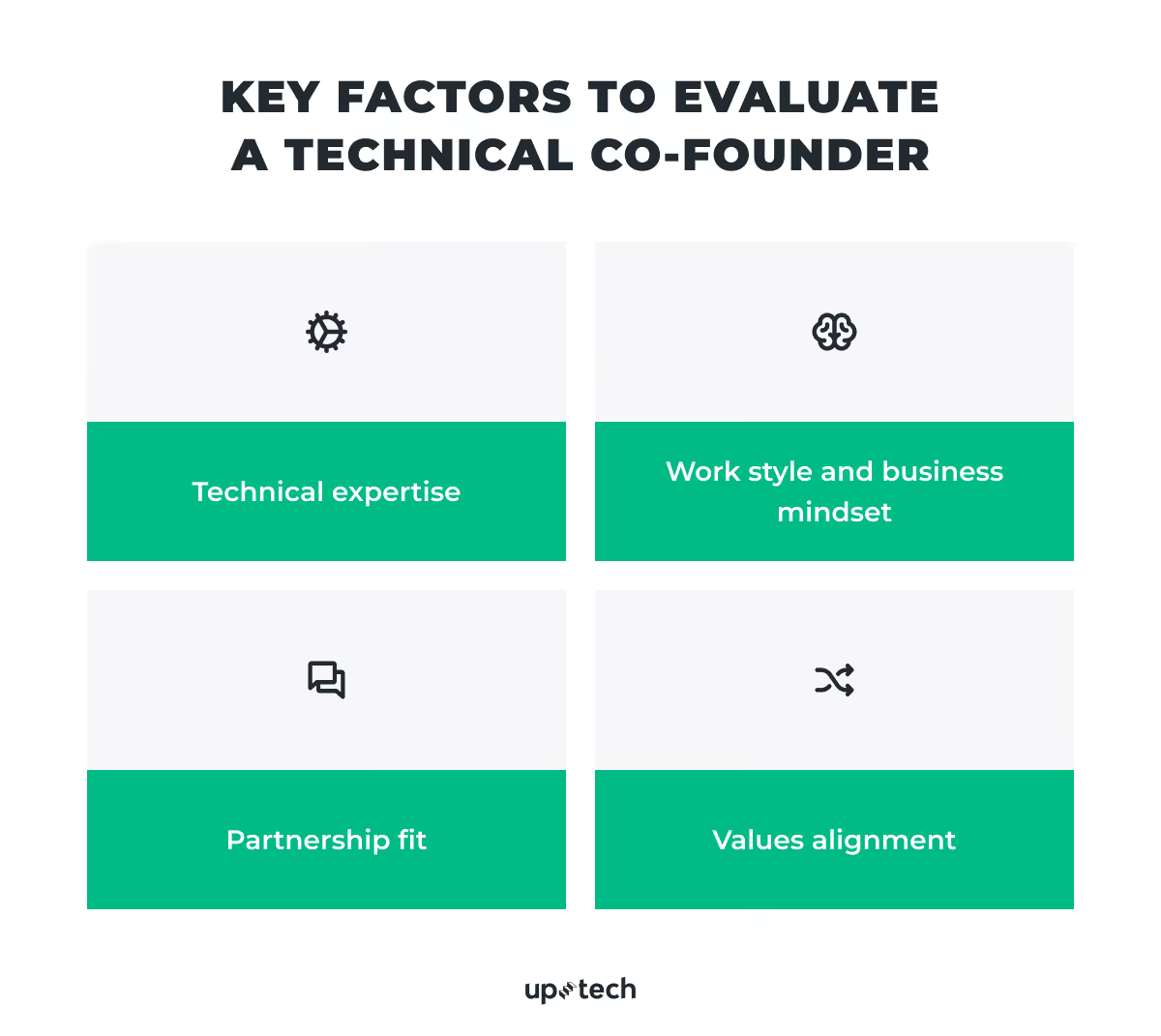
Many candidates can talk convincingly about technology. Fewer can make good architectural decisions under uncertainty, manage technical debt while shipping fast, and build a team around them. The difference matters enormously at the co-founder level.
What to look for:
- Can they explain complex technical decisions in plain language, without losing precision? This is a signal of genuine understanding, not just familiarity with terminology.
- Do they have a track record of shipping products? Prototypes and side projects are useful signals, but production systems with real users are stronger ones.
- How do they talk about past technical failures? Founders who can dissect what went wrong and what they learned are more valuable than those with an unblemished story.
- Ask them to walk you through an architecture decision they made and would make differently today. The quality of their reflection tells you more than the original decision did.
Evaluate working style and business mindset
Technical skills are essential, but they are only part of what makes a strong co-founder. You also need someone who can make decisions under uncertainty, communicate openly, and stay engaged when the business faces challenges.
Over time, these qualities often matter more than technical expertise alone because they shape how effectively you work together and make critical decisions.
What to look for:
- How do they handle disagreement? A strong co-founder can defend their perspective while remaining open to discussion and feedback.
- How do they operate under uncertainty? Early-stage startups require making important decisions with incomplete information.
- Are they motivated by the problem or the title? The best co-founders are driven by the opportunity to build something meaningful, not by a job title.
- Do they understand the business? A strong technical co-founder should understand the customer, the market, and the business model, and consistently account for these factors in technical decisions.
Test the working relationship before committing
No amount of interviewing substitutes for actually working together. Before agreeing on equity or signing anything, find a way to collaborate on a real, bounded piece of work.
How to structure this:
- Run a paid trial project together, scoped to two to four weeks, with a defined deliverable.
- Use the trial to observe how they communicate when things are unclear, how they manage their own time, and how they handle feedback
- Pay attention to how they treat the work when no one is watching. Do they take ownership or wait for direction?
- Look at whether they meet commitments, communicate clearly, and maintain quality throughout the project.
Evaluate values alignment
A co-founder relationship will be tested during periods of uncertainty, pressure, and difficult trade-offs. It is important to ensure that you share similar expectations about how the company should be built and how major decisions should be made.
Questions worth exploring directly:
- Are they prepared for uncertainty and instability? Early-stage startups involve changing priorities, limited resources, and frequent setbacks. Your co-founder should be comfortable operating in this environment.
- What level of commitment are they ready to make? Building a startup typically requires sustained focus over multiple years.
- How do they approach hiring and company culture? Their decisions will shape how the technical organization grows.
- What are they not willing to compromise on? This helps reveal the principles that guide their decisions and priorities.
The evaluation process should be thorough. You want to feel truly confident, not just relieved to have found someone.
Settling for a choice because the search has been long is one of the most common mistakes in early-stage company building. It often becomes clear in hindsight that this decision came from exhaustion rather than sound judgment.
Why Should You Choose Uptech as Your Technical Founder?
Ideas are valuable. However, building a successful product takes much more than just a sketch. You need a dedicated team of product managers, UX designers, and developers to validate your idea and bring it to life.
At Uptech, we go beyond development. We act as a technical partner, helping you shape your product, validate your idea, and build it the right way from the start.
With 10+ years of experience, we help you:
- Choose the right tech stack based on your goals
- Define a focused MVP
- Build scalable, production-ready solutions
We combine your domain expertise with our product development and software engineering experience to reduce risks and avoid costly mistakes early on.
Scaling a ghost kitchen platform: Eatable case study
Eatable set out to build a ghost kitchen platform for restaurant partners, but came in without a clearly defined product or technical direction. The challenge was shaping the product into something scalable and usable.
We stepped in as a technical partner, taking responsibility for how the product should be built and how it should function in the real business context.
This included:
- Leading discovery and turning a broad idea into a structured product
- Defining system architecture and selecting the tech stack
- Aligning technical decisions with business goals
- Owning how the platform performs in real use, not just how it’s built
Key decisions and implementation:
We designed a flexible, AWS-based platform that allowed restaurant partners to manage menus and operations in real time. Menu updates, which previously took weeks, became instant. Onboarding and daily workflows were simplified to reduce friction and support growth.
Outcome:
The first working version was launched in three months, with further development guided by real user feedback and usage data. The platform became more scalable, easier to operate, and better aligned with the business model.
Have an idea? Let’s turn it into something real.
Contact us for a free consultation.
Conclusion
In a nutshell, finding a technical co-founder is like finding the perfect dance partner for your startup journey. You need someone who's as passionate about your idea as you are and who can groove with your vision.
Start by hitting the tech scene like a pro. Attend hackathons, meetups, and online forums to connect with potential co-founders. Show them your enthusiasm and be clear about your project's awesomeness. Transparency and trust are key.
If you need some extra hands to get your software solution off the ground, our expert team can get you the tech help you need.
Don't hesitate to reach out to us at Uptech. We're all about turning ideas into successful products, and we'd be stoked to help you out.




























.avif)